IT → Cybersecurity Job Transition
A 4-Week 1:1 Program to Stop Guessing and Start Moving
Most IT professionals trying to break into cybersecurity waste years guessing their way through the industry, chasing the wrong certifications, applying to roles they are not positioned for, and struggling without a clear direction.
This program fixes that.
You’ll define your target role, build relevant practical experience and a focused skills strategy, position your resume and LinkedIn correctly, and follow a structured job search system tailored to your background and career goals.
Who This Program Is For
This program is designed for a specific type of person. To get strong results from a structured 1:1 process like this, it’s important to come in with some existing IT experience and a willingness to actively apply what you learn.
If your background and goals align with the points below, it’s likely a strong fit and you’ll benefit from the structure and guidance. If not, there are other resources available that may be more appropriate for your current stage.
This is a strong fit if you:
Have current experience in IT (support, systems, networking, cloud, etc.) or strong transferable technical skills
Are looking to transition into cybersecurity in a structured and realistic way
Want a clear, defined path instead of exploring multiple directions without progress
Are willing to execute consistently between sessions
Prefer a guided 1:1 approach instead of figuring everything out alone
This may not be the right fit if you:
Are completely new to IT with no technical background or transferable skills
Are looking for a course to passively watch without execution
Expect guaranteed job placement or immediate results
Prefer a broad, exploratory approach instead of committing to one direction
Are not ready to invest time and money into structured learning and execution
The Most Common Reasons IT Professionals Get Stuck Breaking Into Cybersecurity
No clarity on which cybersecurity role actually fits your background
Conflicting certification advice and learning paths
No practical, job-relevant experience strategy
Resume and LinkedIn do not align to cybersecurity roles
Difficulty translating existing IT experience into security positioning
Applying to jobs without a structured system or feedback loop
Overwhelmed by too many tools, technologies, and specializations
Weak confidence during interviews and technical discussions
No clear understanding of what “job-ready” actually means
Discouragement from unclear process and no validation for efforts
How the Program Works
The process starts with an application and a free call to understand your background, goals, and whether the program is the right fit for you.
If accepted, we work together 1:1 over 4 weeks through structured sessions, practical execution, direct feedback, and “homework” between calls to keep momentum consistent.
The goal is to help you avoid months or years of wasted effort, confusion, and opportunity cost by building a focused and realistic path into cybersecurity.
Here is what you get at the end…
1. Clear cybersecurity career direction
A defined target role based on your background, with a realistic and focused path forward.
2. Role-aligned resume experience
Practical experience aligned to real job expectations, with a clear strategy to build more.
3. Focused skills acquisition strategy
A clear plan for what to learn, what to ignore, and how to prioritize your time and effort effectively.
4. Resume and LinkedIn positioning
A profile that reflects your transition and presents your experience in a way that aligns with cybersecurity roles.
5. Structured job search system
A clear approach and frameworks for applying to jobs, networking, and generating interview opportunities.
6. Guidance and support throughout
Ongoing direction, feedback, and support to help you stay aligned and make correct decisions at each stage.
Weekly Sessions Structure
Each week includes a dedicated 1:1 session focused on your current stage of the transition.
These sessions are used to define direction, review progress, and make clear decisions so you always know what to focus on next.
Between sessions, you continue executing on your plan with access to text support, resources, and structured guidance to keep momentum consistent.
Week 1
Career Analysis & Role Selection
- Review your current IT background and skills
- Understand the main cybersecurity paths most relevant to your profile
- Identify the most realistic target role based on your background
- Use a structured framework to choose one direction
- Create an initial roadmap for what to focus on next
Week 2
Skills & Experience Strategy
- Map the specific skills that matter for your chosen security role
- Build a focused certification strategy with clear priorities
- Select projects and experiences that align with mapped job expectations
- Turn projects into a practical experience-building plan
- Create a step-by-step execution path for your first project
Week 3
Resume & LinkedIn Positioning
- Restructure your resume to reflect your target cybersecurity role
- Position your existing experience in a more relevant way
- Integrate projects as real, practical experience
- Improve keyword alignment for recruiters and ATS
- Refine your LinkedIn profile to match your transition strategy
Week 4
Job Search & Interview Strategy
- Build a structured approach to job applications
- Learn how to target the right roles instead of applying broadly without structure
- Create a practical networking and outreach plan
- Prepare for interviews with role-aligned positioning
- Leave with a repeatable system to continue after the program
Prefer a Faster Option?
If you don’t need the full transition, just help with one specific thing, I offer a 1-Hour Session instead.
One focused conversation on whatever’s actually blocking you: your resume, a portfolio project that needs a second set of eyes, an upcoming interview, a certification decision, or general direction if you’re stuck. You pick the topic, we go deep on it.
Best for people who don’t need ongoing support, just clear, actionable feedback on one thing, fast. No application required, just book a time.
Why should I be the one guiding you through?
I’m a Senior Security Analyst at Deloitte with experience across cybersecurity, cloud, compliance, automation, and AI in enterprise, healthcare, government, and SaaS environments.
I started in IT support, in the same position many people are in now, trying to figure out which skills mattered, how to build experience, and how to transition into cybersecurity without wasting years guessing.
I transitioned into cybersecurity through structured execution, practical projects, continuous learning, and clear positioning instead of relying on random advice.
Since then, I’ve built tools, study resources, guides, and educational content used by thousands of people navigating cybersecurity.
This program is built to give people the structure, direction, and execution I wish I had when starting out.

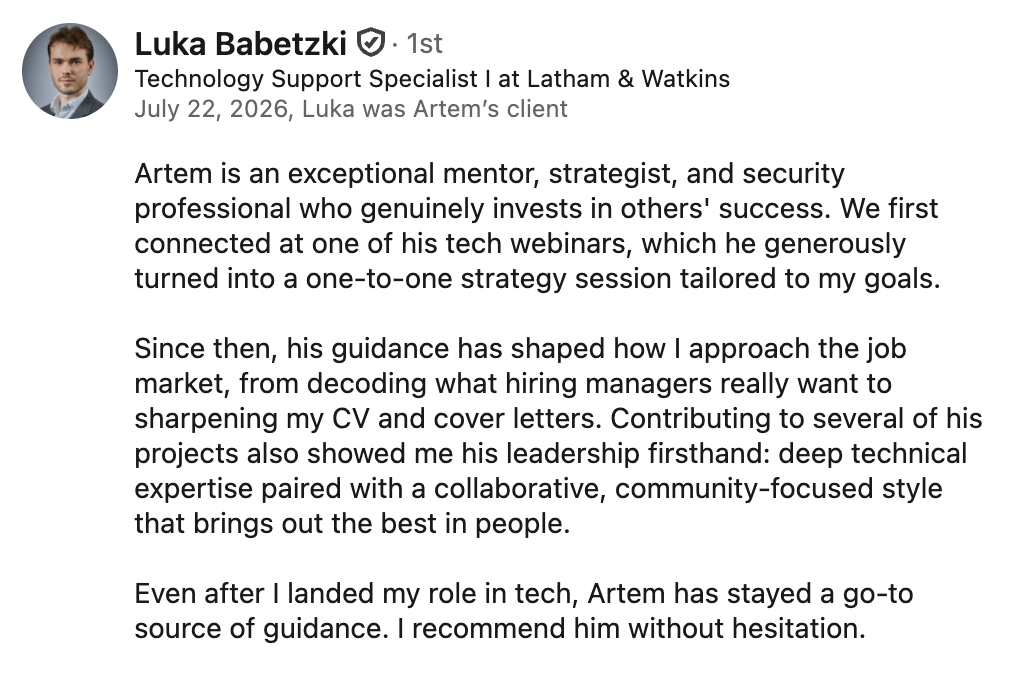
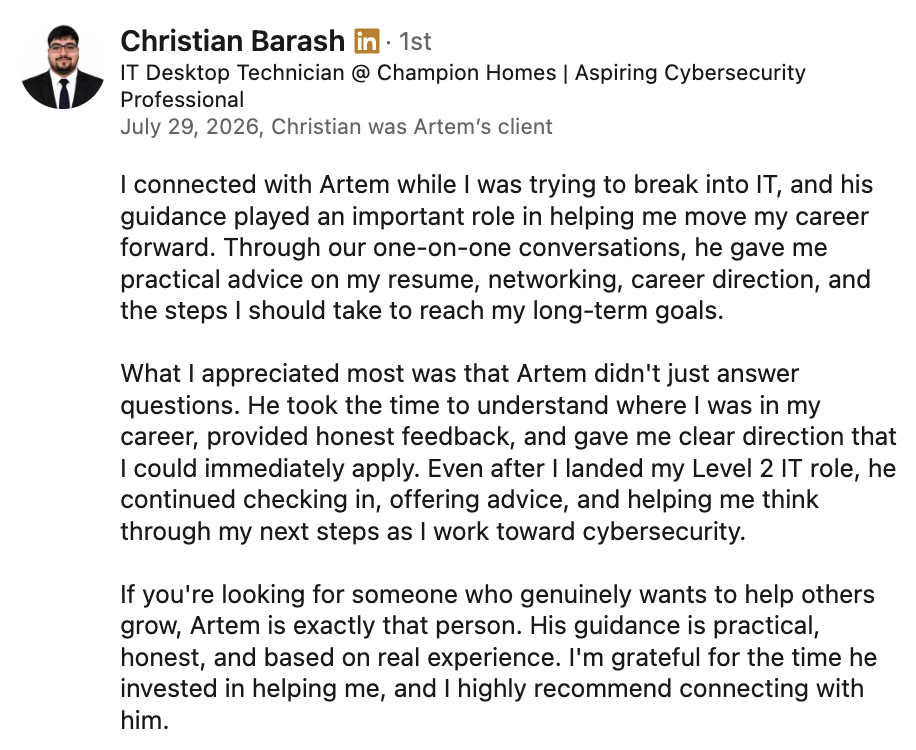
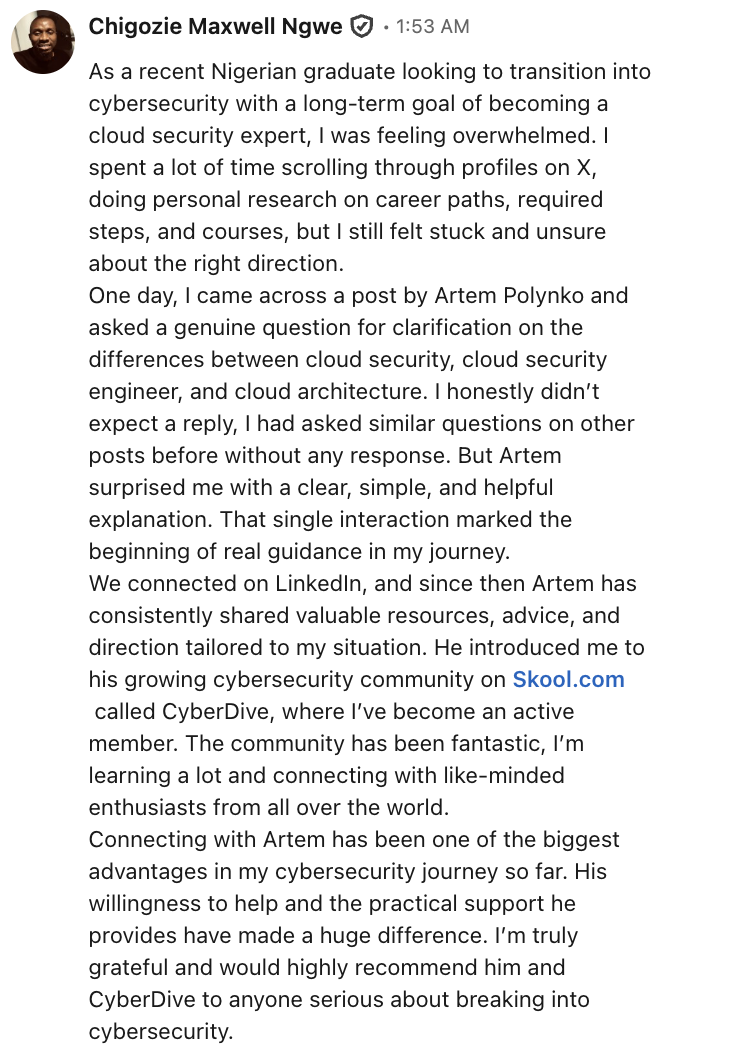
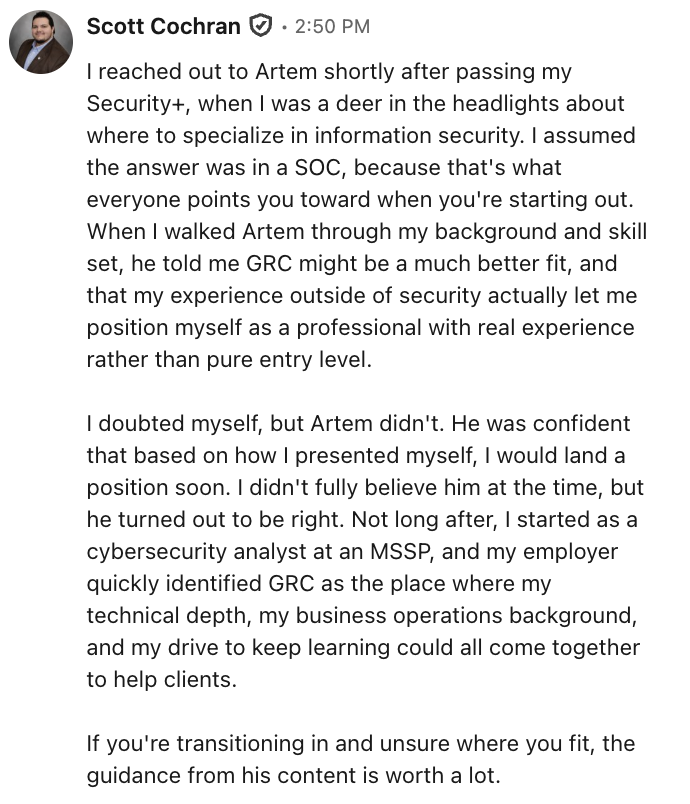
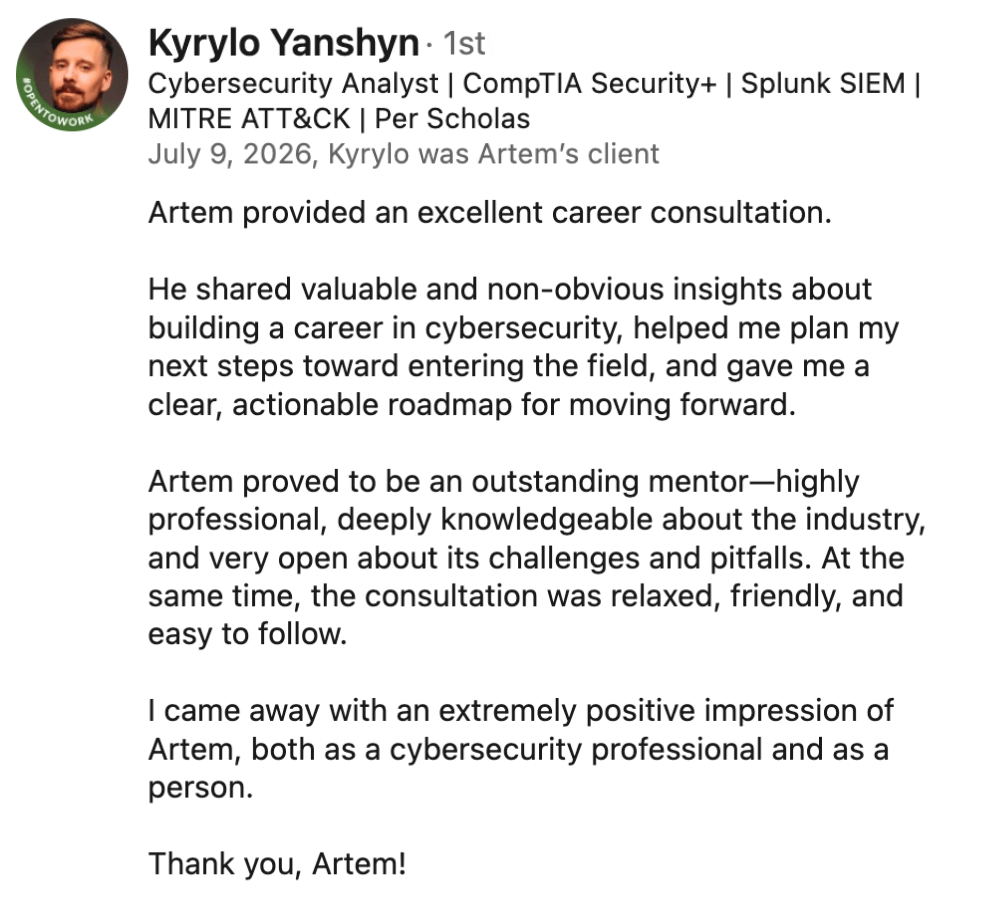
Feedback From People I’ve Helped
My Guarantee to You
This guarantee applies to the full 4-Week Program.
I stand behind this program completely. If after your first session it’s not the right fit, let me know and you get a full refund.
If you complete all 4 sessions and do the work but leave without a clear target role, a skills roadmap, an optimized profile, and a reliable job search strategy, I’ll work with you for 2 additional sessions at no charge.
Apply for the Program
Most Frequent Questions
How much does the program cost?
What if I’m not ready for this yet?
If you’re earlier in your journey, you may benefit more from:
- CyberDive Community → structured learning + projects
- Security+ Simulator → certification preparation
- Certification Guides → focused study resources
These are better suited for building your foundation first.
Do I need prior IT experience?
Yes, this program is designed for IT professionals.
A basic foundation in IT (support, systems, networking, cloud, etc.) is important to get meaningful results from the process.
Is there a faster option than the 4-week program?
Yes. If you just need a focused session to drill down on specific parts of the transition, or you’ve already made progress and don’t need the full 4-week process, I offer a 3-hour Intensive Session instead.
It covers career audit, role selection, certifications, project ideas, resume/LinkedIn direction, job search strategy, and an action plan, all in one private session. Mention it when you apply and we’ll figure out which option fits you best.
Is this a course or coaching program?
This is a 1:1 coaching program.
Each week includes a dedicated session focused on your specific situation, along with guidance and support between sessions. It’s structured around execution, not passive learning.
Is there a job guarantee?
No, this is not a job placement service.
The program is designed to help you build the right direction, experience, and strategy to improve your chances of getting interviews and offers.
How much time do I need to commit?
You should expect to actively work between sessions.
The program is structured around execution, so progress depends on applying what we define each week.
Will you do things like full resume writing or applying for me?
No, the focus is on guiding you to do it correctly yourself.
You’ll receive structure, feedback, and direction, but the execution is yours.
What happens after the 4 weeks?
You leave with a clear system to continue executing, including:
- A defined path and priorities
- Experience-building plan
- Resume and positioning
- Job search strategy
The goal is to make you independent, not reliant on the program.